Financial Hygiene for Real Estate Professionals
Let's get right to it.
Hygiene; Discipline; Habits are rarely interwoven in Financial Health. Yet that is exactly where your Financial Health lives -- Not in how much you earn, but in what you do with what you earn, at the moment you earn it.
This is a simple paradigm I help those I coach use -- a way of thinking about their earnings first, and only then a way of handling them. I am sharing it with every Real Estate Professional because I feel strongly that this type of thinking can empower you to flourish.
You do Not get paid like a job -- you get paid in spurts
Real Estate Agents do Not make money like a job. There is No steady weekly amount, No predictable monthly amount. You make money here and there, when a transaction closes.
That is Not a flaw in this career. It is the shape of this career. The problem is Not the spurts -- the problem is what happens when money that arrives in spurts is treated as if it were a salary.
When a check arrives after weeks of work, it feels large. It feels like a reward. And if there is No decision already made about what that check is for, the check simply gets absorbed: a bill here, a purchase there, a little breathing room, and then it is gone. Then the quiet weeks come, the tax bill comes, and the same agent who just closed is scrambling.
The agents who stay calm between closings are rarely the ones who earn the most. They are the ones who sliced the last check properly.
Financial Hygiene is Not about being wealthy. It is about Being Ready -- for taxes, for a slow month, and for your own future.
Decide at the closing, Not later
Here is the principle that runs this entire post, and it is simple:
The Principle -- As you earn money, you make the decision of what to do with your money right then and there -- Not Later.
Later is where good intentions go to disappear. Later, the money has already been spent in your mind ten different ways. Later, there is always a reason to start next time.
At the closing, none of that has happened yet. The check is whole. That is the one moment when a clean decision is easy. So we do Not decide what to do with what is left over. We slice the whole check, on purpose, the moment it arrives -- the same way, every time, until it becomes who we are as Professionals.
The system: Slice every check 70 / 15 / 10 / 5
Before the system can work, the money needs somewhere to go. Set up four places in advance, so a closing never has to wait for you to get organized: a Business Checking account, an Obligation Savings account for taxes, a Long-Term / Rainy-Day Savings account, and a Long-Term Investment account for diversified funds.
Then, every check, without exception, is deposited in the same four slices:
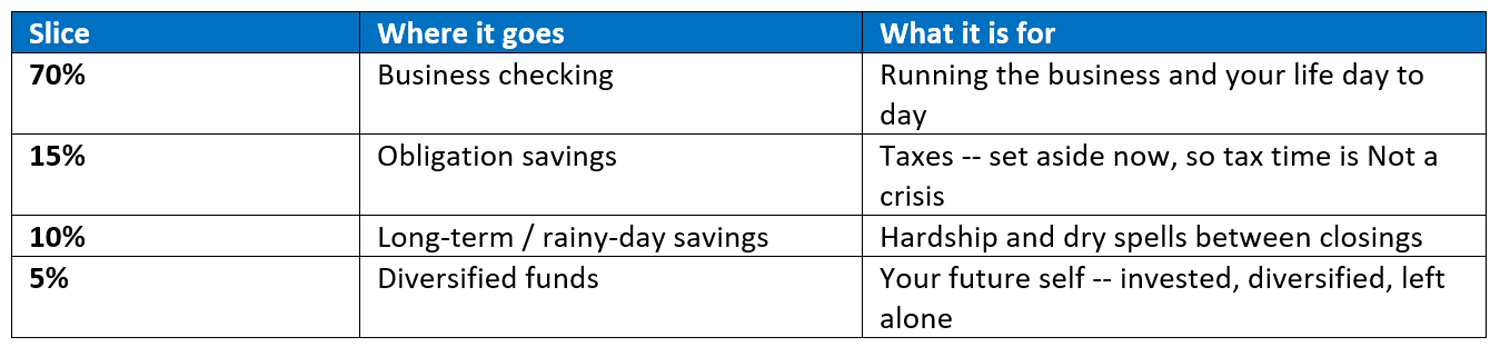
Notice what the order teaches. The business is funded first, because the business Must run. Taxes are protected second, because they are Not optional. The rainy day comes third, because in this career a rainy day is Not a possibility -- it is a schedule you simply have not seen yet. And the future self is paid last in the list, but paid every single time, because a small slice repeated for years is how a future is actually built.
Let’s See it on a real check
Take a familiar example. You list and sell a property at $350,000, on the listing side at 3%. (nicely done...)
The gross commission is $10,500. After your split and transaction fees, you get about $7,000. That $7,000 -- the check your broker writes to you -- is the number we slice:

Read that once more, slowly. Nothing in it is dramatic. That is the point. $350 to your future does Not feel like much at one closing -- and ten, twenty, fifty closings later, year in and year out, it is no longer $350. Discipline compounds before money does.
What each slice is really doing for you
The 15% -- Obligation Savings. If you made a profit, you will owe taxes. That is Not a surprise and it should never be an emergency. When 15% of every check has been quietly held back, the money to pay is simply there.
The 10% -- Long-Term and rainy-day savings. Closings do Not arrive on a schedule. Cars break, deals fall through, closings are postponed. This account is what lets a slow stretch be a slow stretch, instead of a panic.
The 70% -- Business checking. This is the money the business and your household actually live on. Because the other three jobs have already been taken care of, this 70% can be spent with a clear head. You are Not quietly spending your tax money and calling it income.
The 5%: Invest in Funds -- Not in individual stocks
Invest the 5%. But do Not invest it willy-nilly, and do Not buy individual stocks. You should be focusing on your next Listing, Not your next stock.
A fund holds many companies at once, in one purchase. When you buy a total market fund, you are Not betting on one company being clever. You are owning a broad slice of the market itself, diversified by design. Look at the statement when it comes, and leave it alone.
And yes -- keep buying Real Estate if you are doing well. This is Not an argument against what you know. It is adding the one thing your career does Not give you on its own: Diversification away from Real Estate, because you are already in Real Estate -- your income, your expertise, and very likely your properties all rise and fall with the same market.
How the 5% changes with your age
Is there a formula for different ages? Yes. As you move from one age group to the next, you tweak the mix -- younger means simpler and more growth-oriented; older means more bonds, more income, and more calm. The framework below follows the approach shared by former financial advisor Tyler Gardner, whose work on funds by age pairs naturally with the 5% slice in this paper. Video: https://www.facebook.com/reel/1848255666215797
Five funds cover almost everything an agent in this system will ever need:
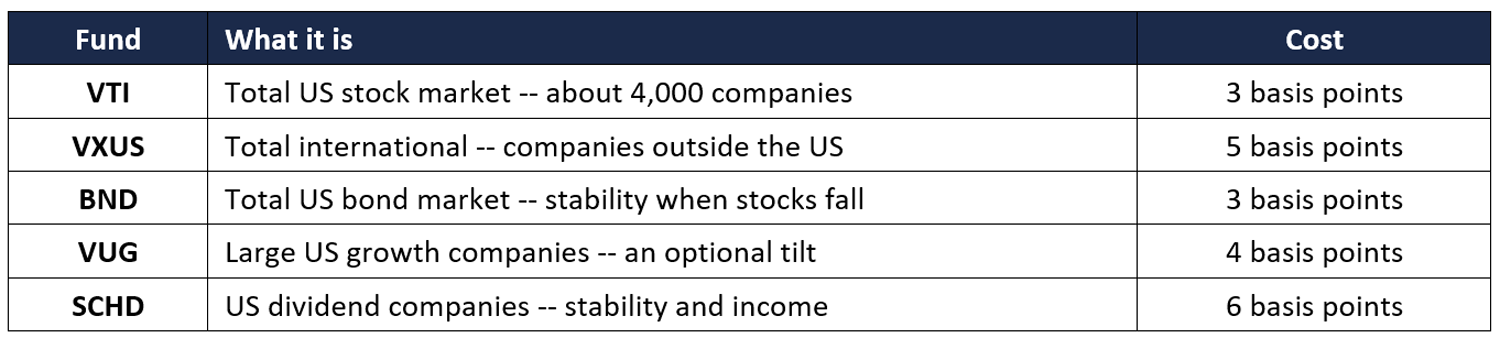
A basis point is one-hundredth of one percent. At 3 basis points, the cost is $3 a year on every $10,000 invested. Low cost matters because the fee is a fact, while every forecast about performance is only a forecast. Equivalents exist at Fidelity and Schwab for most of these funds; what matters is the idea and the cost, Not the brand.
The first three funds alone -- VTI, VXUS, and BND -- are a complete portfolio, Not a starter portfolio. That is essentially what a target-date retirement fund holds. The last two are optional tilts, and a tilt is exactly what it sounds like: VUG holds companies you already own inside VTI, just weighted more heavily toward growth, which means a rougher ride in both directions. SCHD pays part of its return as dividends -- cash instead of price growth.
Now, the mix by age -- or how to sub-slice the 5% into various investment funds.
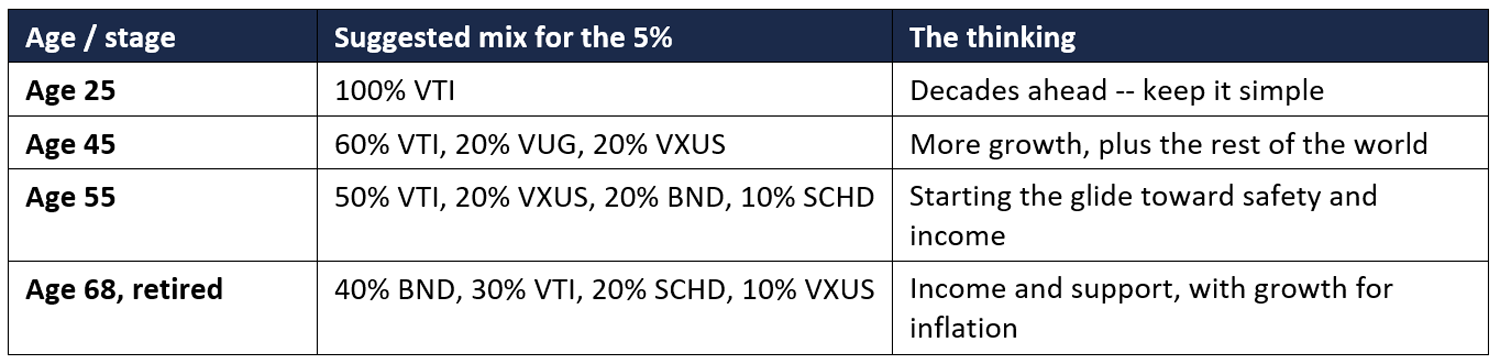
Why do bonds appear as you get older? Bonds are Not there to make you money. They are there so that when stocks fall hard, you have something to sell that has Not also fallen hard.
Get and Share the full detailed White Paper
I have put a very detailed complete PDF -- the four accounts, the closing-day checklist, and the funds-by-age framework -- into a White Paper:
Download the White Paper (PDF)
Your Closing-Day Checklist
1. Deposit the check and slice it the same day: 70% business checking, 15% obligation savings, 10% long-term / rainy-day savings, 5% to your investment account.
2. Do Not borrow from the obligation account. The money is already spoken for.
3. Invest the 5% in diversified funds at the mix for your age. Do Not wait for a better moment.
4. Record the closing. One line is enough: date, amount kept, and the four slices.
5. Then go back to work -- Get the Next Listing. Do Not watch the funds.
Start with the next check. You do Not need to fix the past, and you do Not need a large closing to begin. Open the accounts. Take your next check -- whatever its size -- and slice it 70 / 15 / 10 / 5. That one closing, handled like a Pro, is the beginning of the habit. The habit is the whole system.
--- Some Quotes and Affirmations to consider below Graphic:
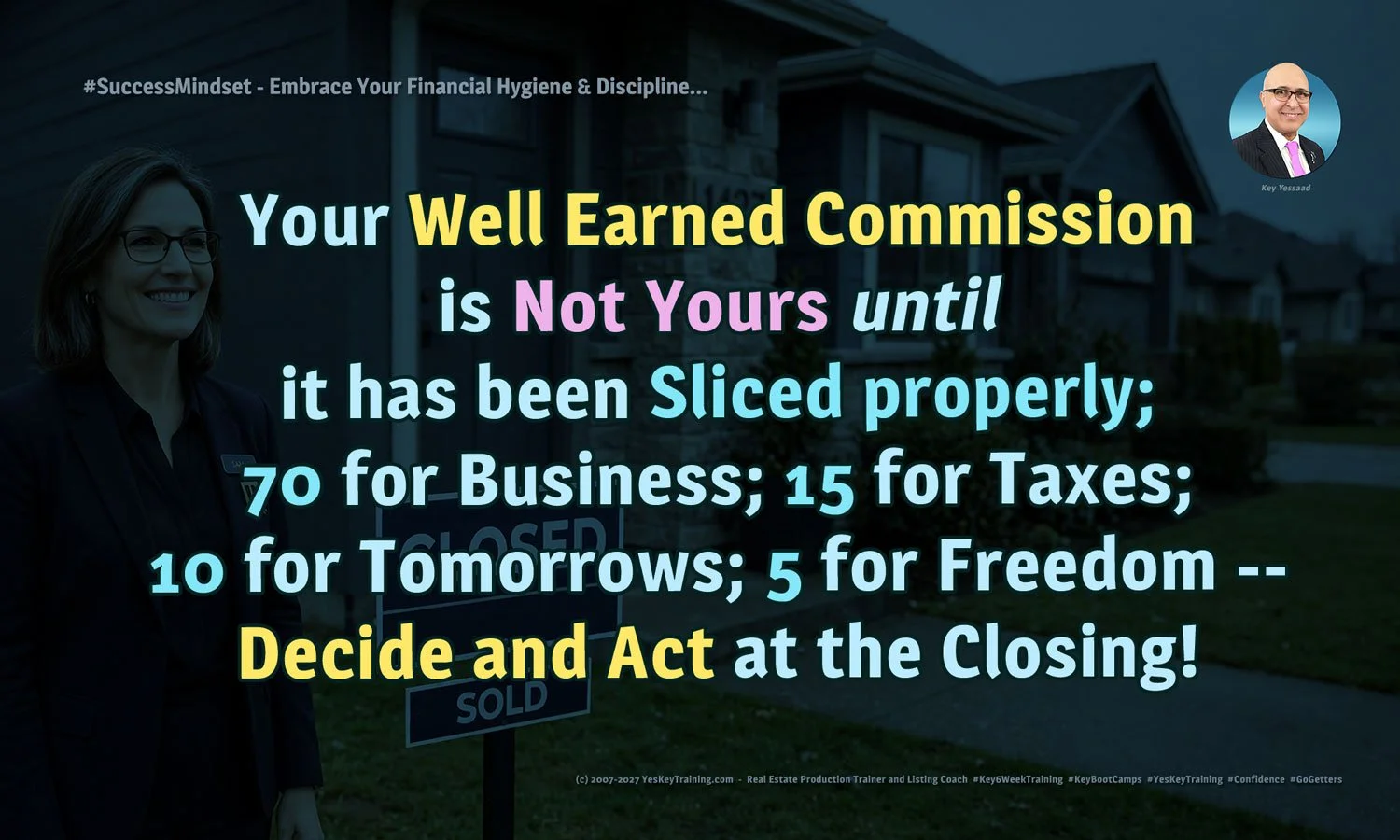
Reflect on these Quotes and Affirmations -- I invite you to write a few of your own -- share blog link:
Quote: “Discipline compounds before money does.”
Quote: “The habit is the whole system.”
Affirmation: “I decide at the closing -- Not later.”
Affirmation: “I slice every check 70 / 15 / 10 / 5, every time.”
Affirmation: “I pay my future self at every closing, then I go Get the Next Listing.”
Author: With over two decades of experience, Key Yessaad is a Dynamic Real Estate Trainer and Production Coach specializing in Activity-Based Coaching. Key’s signature programs - including the “6-Week Prospecting Trainings” and “3-Month Production Boot-Camps” - equip Agents and Brokers with Practical Skills in Time Blocking, Prospecting, Script Mastery, Listing Presentations, and Getting Listings. By instilling Accountability, Self-Discipline, and a Mindset of Action over Theory, Key empowers professionals to achieve measurable, lasting success in today’s competitive Real Estate landscape.
Related HashTags: #FinancialHygiene #ManagingYourEarnedCommission #RealEstateAgents #RealEstateBrokers #Commission #MoneyDiscipline #FinancialDiscipline #RealEstateTraining #ListingAgent #Mindset #YesKeyTraining #SuccessMindset